
A welcome from
Marta Cyhan-Bowles
We’ve recently had an incredible opportunity to speak directly with chief marketing officers (CMOs) across industries about the challenges shaping their world. What struck me most is how universal these challenges are—whether it’s navigating fragmented data, proving return on investment (ROI) under tighter budgets, or integrating artificial intelligence (AI) in ways that deliver real business value.
Despite the complexities, one theme stood out: resilience. CMOs are drawing on creativity and business acumen to solve problems that have no easy answers. They’re balancing short-term performance with long-term brand building, finding clarity in a sea of data, and leading their organizations through disruption with confidence and purpose.
This year’s CMO Outlook: Guide to 2026 reflects those conversations and the survey feedback from other senior marketing leaders across the globe. It offers insights into the contradictions they’re grappling with and provides actionable strategies to turn these challenges into opportunities.
As you read, I hope you find inspiration and practical guidance to help you lead with confidence in the year ahead.

Chief Communications Officer & Head of Global Marketing COE, NIQ
Marta Cyhan-Bowles is Chief Communications Officer & Head of Global Marketing COE at NIQ. A proven marketing and communications leader, Marta specializes in guiding teams toward long-term customer success through data-driven rigor and a personal bias for innovative campaigns that captivate, engage, and ultimately drive measurable growth. As head of the Global Marketing COE, she leads the charge in unifying the global team at NIQ across communication and thought leadership efforts to unlock transformational value for C-suite leaders across the retail and manufacturing sectors.
Read the full report now.

Chapter 3:
The insights imperative
For CMOs, data and insights have become even more critical to their remit: The ability to move from signal to decision quickly is what separates reactive marketing from resilient leadership. Although marketing leaders have no shortage of data at their fingertips, their ability to elicit actionable insights that drive the organization forward is only as good as the systems that support it. But when it comes to those systems, many have mixed views.
Increasing percentage of CMOs complain of time lag from data to
decisions
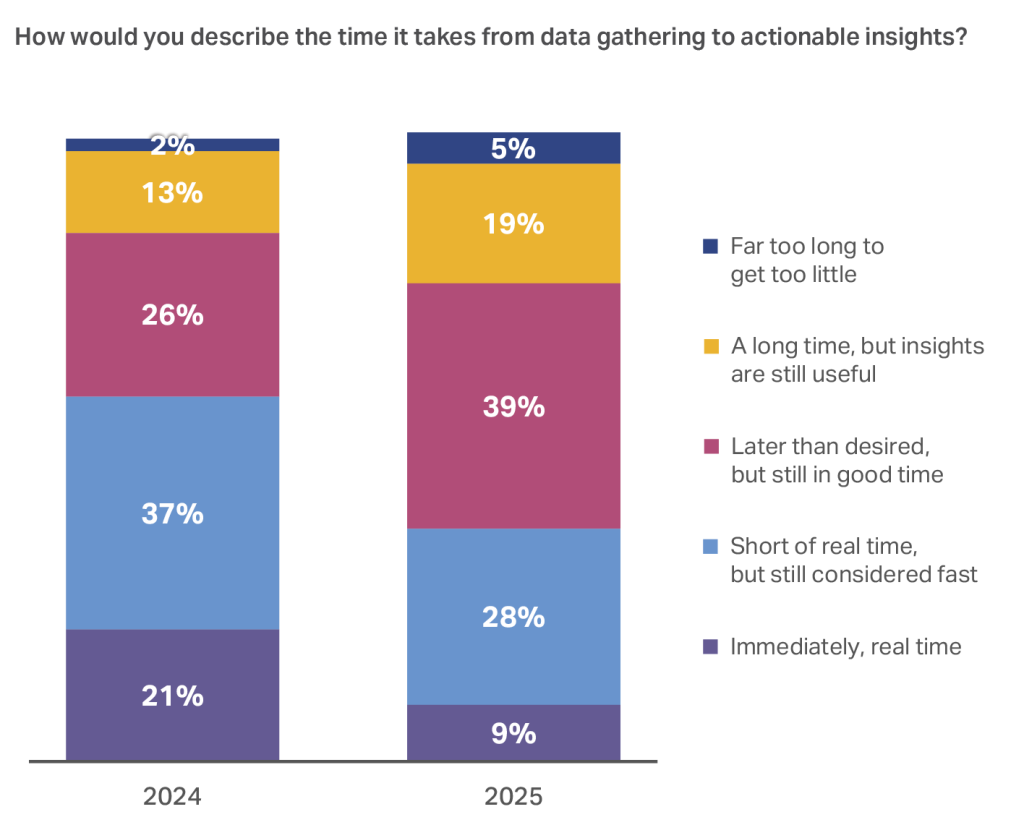
While only a small percentage (9%) say they’ve unlocked “real-time” insights, none said the lag time was so long that it invalidated the data’s utility. This means the majority of CMOs are somewhere in the middle, where they consider their data-to-decision pipeline as “fast” or “in good time.”
But speed isn’t the only critical factor when it comes to turning insights into action. Doing so also requires the right mix of tools, talent, and internal alignment to connect disparate data sources and extract clear, actionable conclusions. And, according to our survey, that’s where many CMOs are still finding friction.
When asked where the industry is currently keeping pace with their performance measurement needs, CMOs pointed to measuring marketing ROI (46%), understanding customers (41%), media planning and optimization (40%), and content/creative generation (39%) as areas of relative strength. These functions align closely with the same areas for which CMOs say data play a fundamental role in decision-making: marketing ROI (64%), media planning and optimization (44%), and customer understanding (37%).
"We pulled back on spending early, thinking it would be ‘one of those years.’ Now the 2026 planning process is more data driven because of that—and the environment we’re in."
—Eddie Pellegrino, President, Heartland Food Products Group
CMOs’ top areas for performance measurement and data-driven decision-making
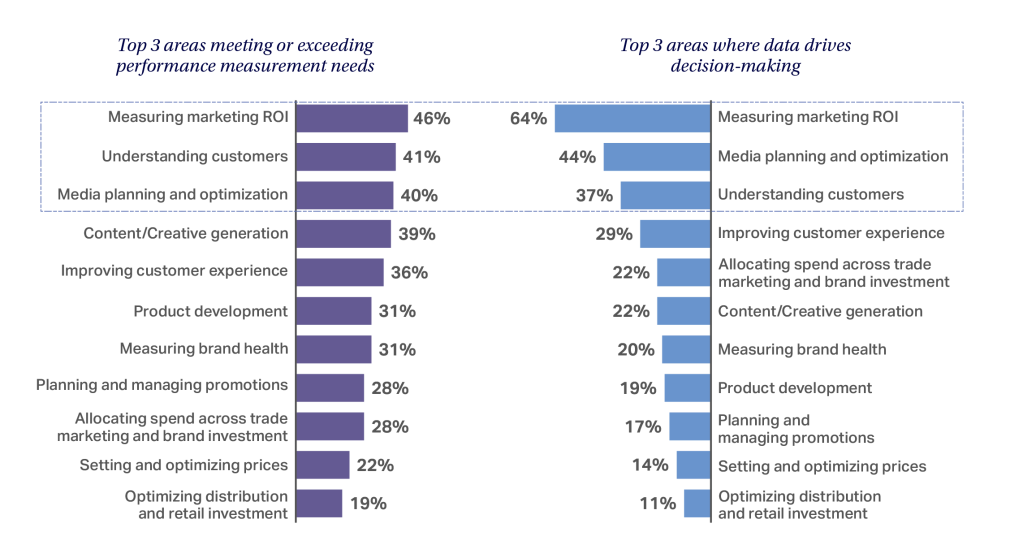
This alignment is not coincidental. Rather, it reflects where pressure is likely the highest for marketing teams right now: spend justification, channel and messaging refinement, and more meaningful customer engagement. It also signals that, despite volatility, CMOs are trying to anchor their strategies in insight.
Interestingly, we also see synergy between these critical areas and where CMOs feel their organizations are performing well: media planning and optimization (39%), content/creative generation (37%), and just slightly behind, understanding customers and measuring ROI, each at 35%. While this finding on the surface is a positive one for these areas, these percentages denote that fewer than half of CMOs share this confidence. It also raises the question as to whether these areas are truly outperforming—or whether they are simply better measured or receiving more resources. Either way, the net of these responses highlights a gap for measurement capabilities across the full marketing ecosystem.
But closing it comes with challenges: One of the biggest impediments CMOs cite for achieving their data and insights potential is connecting data across sources.

Barriers to brilliance: Top challenges marketing teams face
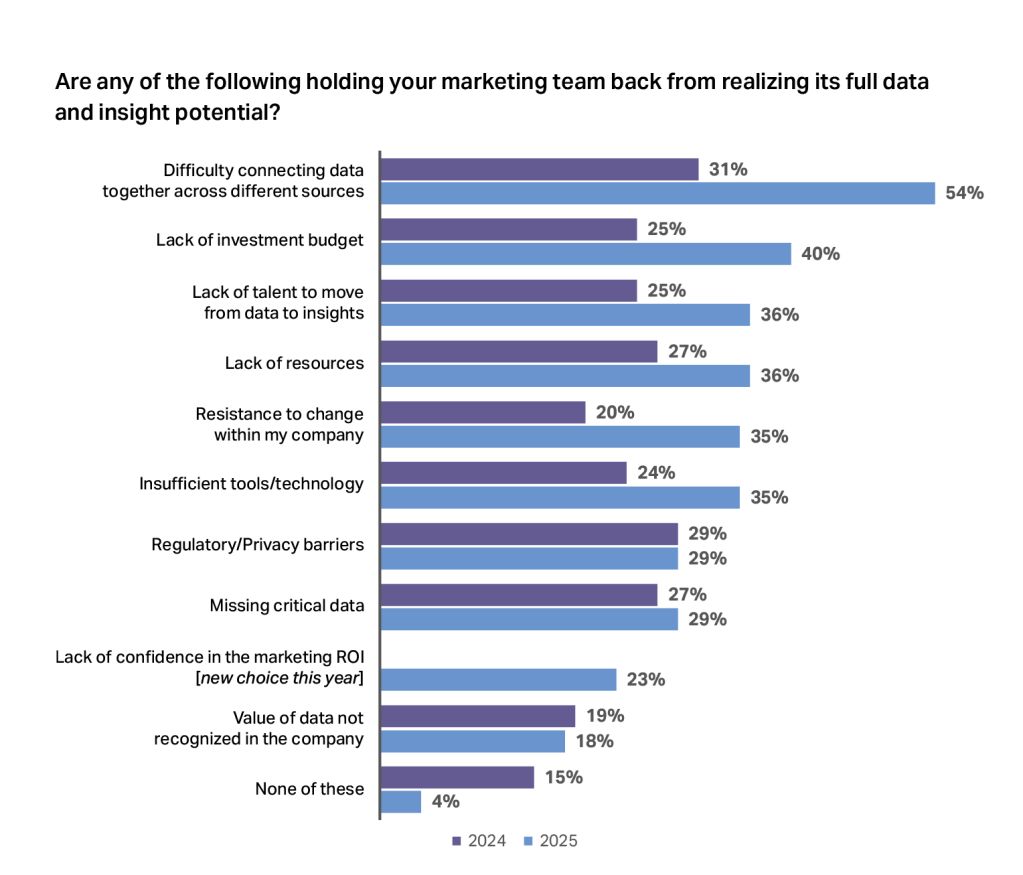

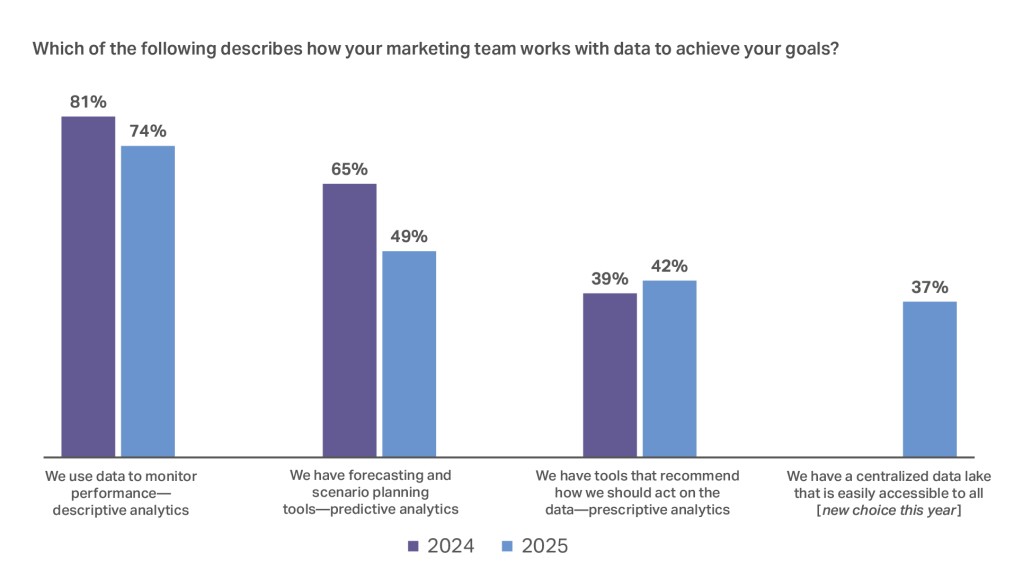
Compounding this challenge is a lack of investment budget, followed by lack of talent. These barriers may be more intertwined than they appear: Only 37% of CMOs say they have a centralized data lake that’s easily accessible to all stakeholders—a foundational capability that requires both funding and cross-functional buy-in. Without access to integrated, usable data, teams are limited in their ability to build skills, experiment, and generate meaningful insights.
Phrased differently:
Closing the accessibility gap may be a critical step in closing the capability gap, but doing so will likely require investment and alignment beyond the marketing function itself—an investment many leadership teams have been hesitant to make.
CMO confidence in data systems’ adaptability drops year over year
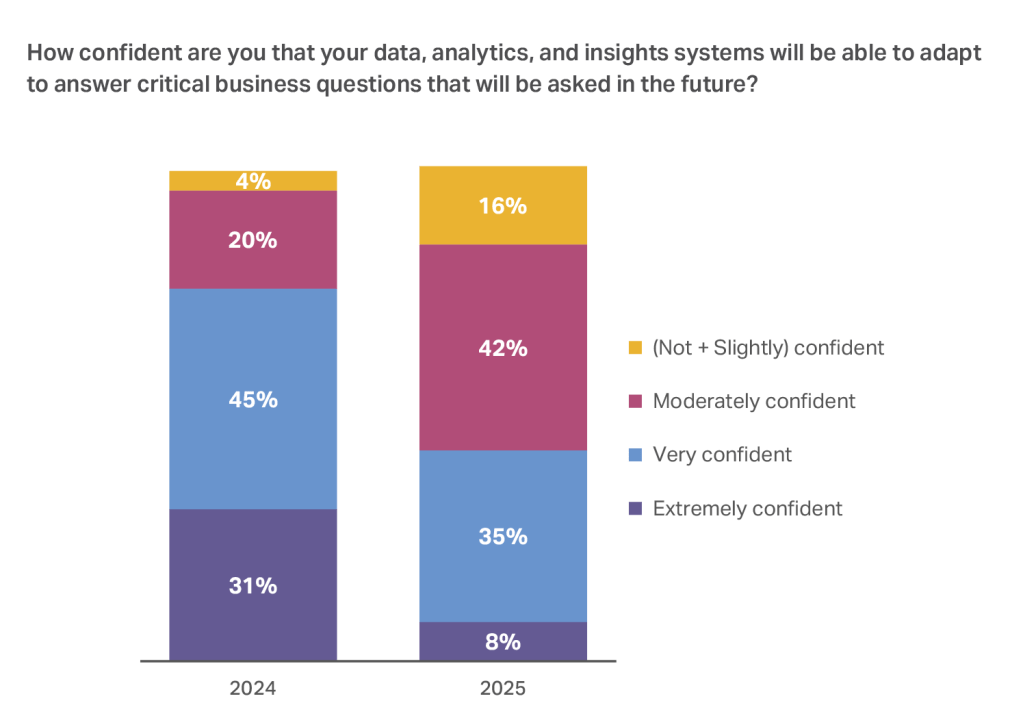
Finally, compared with last year’s survey results, confidence in the futureproofing of their current data and insights capabilities is down. But it seems that CMOs are slowly moving the needle on how they leverage data—perhaps in response to the increased pressure to do so. While most (74%) CMOs still said they primarily rely on descriptive analytics, this number was down from last year’s 81%. Meanwhile, the gap between prescriptive (42%) and predictive (49%) analytics usage seems to have grown closer year over year. Although there’s still room to grow their data sophistication, the accessibility and resourcing gaps noted above may be holding CMOs back from doing so.
Data sophistication: How far along the analytics journey are most CMOs?
Key takeaways
- CMOs have mixed feelings about their future-state data and insights capabilities, which appears to be at odds with their general optimism about future-state performance of their teams, signaling that it’s never been more important for CMOs to prioritize data quality, analysis, and cohesion—and to effectively communicate the results with appropriate stakeholders.
- Overall, CMOs identified measuring ROI, media planning and optimization, and understanding customers as key areas for data-driven decision-making and strong organizational performance. But the distribution of their responses indicates their confidence is far from universal, raising a critical question: Are these functions truly outperforming—or simply known areas of focus and prioritization?
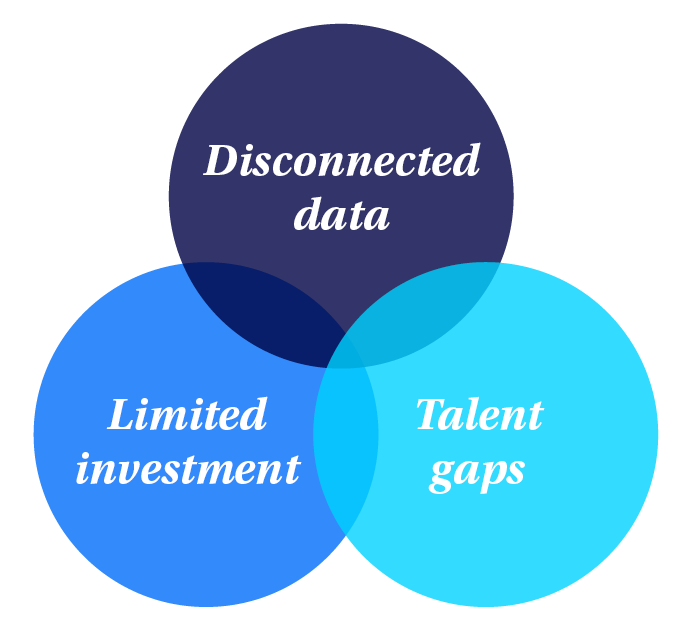
- Disconnected data, reduced budgets, and talent gaps remain CMOs’ largest challenges. While portions of these can be solved for within the marketing department, many of the solutions depend on cross-functional partners’ support. CMOs remain tasked with delivering more across the board, on far leaner budgets.
The biggest barriers to unlocking full potential?

Chapter 4:
The ROI reckoning
Navigating the measurement maze
In our previous chapter, we noted that CMOs prioritize ROI measurement and have confidence in both the industry’s ability to keep pace with their measurement needs, as well as (perhaps to a smaller extent) their own performance in this area. To that end, 84% of CMOs also cited marketing ROI as their most popular metric for allocating budget across media portfolios.
Yet when we zoom in on the present-day dynamics of media strategy and measurement specifically, the picture becomes more nuanced.
With more channels than ever to connect with their customers, CMOs are tasked with strategically wrangling these touchpoints into a frictionless ecosystem that prioritizes seamless engagement and path to purchase. But doing so isn’t easy: Walled gardens, growing privacy regulations, and the sheer number of on- and off-platform channels—each with their own creative format, pricing model, and dashboards—make holistic ROI measurement challenging.

How are CMOs addressing it?
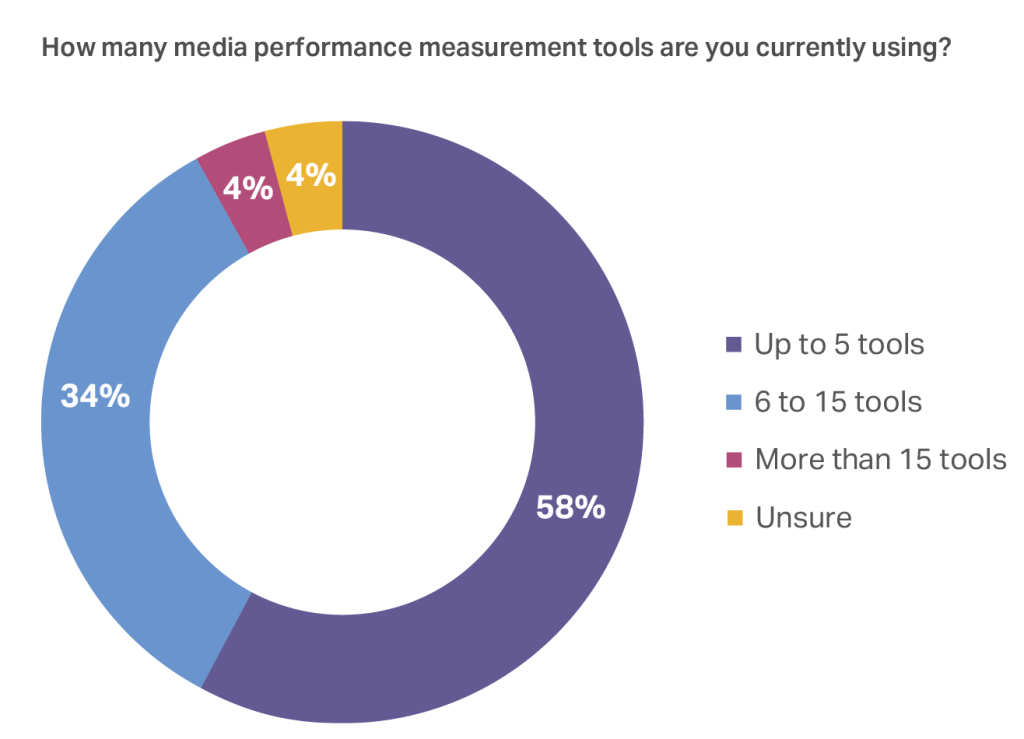
According to our survey, their two most important media investment strategies are “prioritizing flexibility and agility within our media investments” and “investing in new tools or platforms to improve media measurement and attribution”—indicating that the two likely go hand in hand. In fact, CMOs say they’re using multiple tools to measure ROI—in one-third of cases, 6 to 15 tools and, in rare cases, more than 15!
CMOs relying on multiple tools to measure performance

When it comes to channel investment, however, CMOs are stacking their bets in digital media: A study conducted earlier this year found that digital comprises 61.1% of total marketing spend—a finding that reflects our own. When it comes to media planning and optimization, 62% of our surveyed CMOs say that digital channels provide the best performance, while 75% feel empowered with the information they have to make decisions about—and allocate budget across—digital channels.
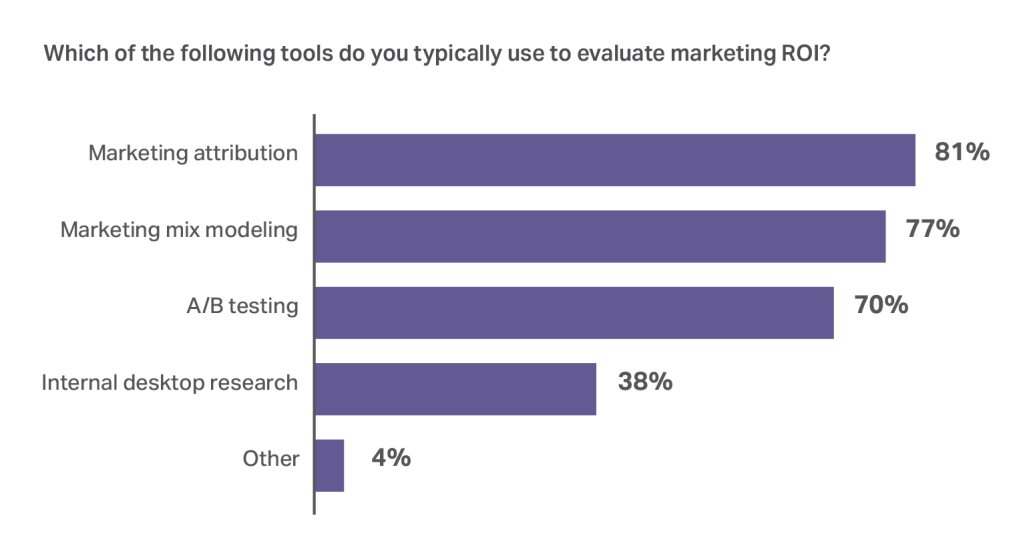
On the one hand, these insights are unsurprising: Digital channels offer faster feedback loops, greater flexibility and scalability, and the ability to precisely target audiences—a lever 78% of our CMOs rank as having a significant impact on generating ROI. Importantly, digital channels also typically provide better attribution capabilities, which 81% of our respondents say is a method they use to measure their ROI.
On the other hand, digital channels are also the most fragmented sources of data, exacerbating the biggest struggle CMOs report having: the ability to connect the dots across their entire marketing efforts.
To bridge these gaps, many are turning to advanced analytics like marketing mix modeling (MMM) to bring together highly granular sources of omnichannel data that reveal what’s actually driving results. And as AI technology evolves, there’s even more promise in its growing capabilities to make this process more efficient and accessible—democratizing insights for all.
How CMOs measure marketing ROI
Creative quality: An ROI blind spot?
With budgets under scrutiny and allocation decisions hinging on performance, CMOs must probe deeper to identify the “why” behind their ROI: Which variables are driving it, and where is there room for optimization?
In our survey, we asked CMOs to identify the levers they feel make a significant impact on marketing ROI:
- Audience targeting and reach: 78%
- Campaign structure and execution: 69%
- Creative: 60%
- Media mix: 58%
The sizeable gap between perceived effectiveness of targeting and reach versus creative raises a complicated question: Are CMOs missing opportunities by undervaluing creativity?
The research points to yes.
The rise and evolution of digital and programmatic technology over the years has been met with justifiable enthusiasm from marketers. For many, its ability to target audiences with precision—personalizing and serving content to the right person, in the right place, at the right time—has swung the pendulum away from creative refinement and toward an emphasis on reach and execution.
But this shift has come with a cost: Even with on-point targeting and flawless execution, lackluster creative can tank an entire campaign. On the flipside, great creative can empower those carefully constructed media plans to deliver at their fullest: Research from NIQ and others has found that it can generate up to 50% in sales lift. And beyond the short-term impacts, great creative also triggers long-term brand recall—embedding into consumers’ implicit connections, associations, and memory—ultimately driving decision-making.
As CMOs reassess their short- and long-term brand strategies to account for shifting consumer demands, it’s clear that creative is a critical lever for success. But just as with any strategic investment, marketing leaders must prove its impact on business outcomes, which can be complicated. Not all creative serves the same purpose, and the definition of “creative” itself is constantly expanding. Today, creative spans AI-generated content (such as ads and copy), creator-driven content (like social posts and reviews), and experiential activations (including augmented reality, installations, and pop-ups). Each of these requires distinct measurement approaches, yet they must also integrate seamlessly with traditional creative elements.
CMOs identify top levers
that make a significant
impact on marketing ROI:
78%
Audience targeting and reach
69%
Campaign structure
and execution
60%
Creative
58%
Media mix


How can marketing leaders ensure they’re giving creative its due as an ROI driver?
- Treat creative as a modeling variable: When developing your MMM or ROI modeling strategy, include measures of creative—such as message variants, quality scores, and reach—alongside media spend, channel, and other variables.
- Ensure creative data is captured consistently: Standardizing, codifying, and quantifying measures such as format, messaging, platform, and audience can help models isolate incremental impact.
- Build an operational loop: Once you’ve included creative performance as a variable in your modeling, you can estimate its creative impact and validate through A/B testing or other experimentation. Use those findings to inform creative planning and budgeting.
- Measure consumers’ explicit and implicit responses to creative: While traditional ad testing methodology like survey questionnaires can provide helpful direction, combining it with non-conscious measures like emotional responses can unlock invaluable insights and empower marketers to pinpoint areas for optimization.
Creative development is a powerful ROI enabler. CMOs who measure and optimize their creative effectiveness alongside other key levers for growth can unlock strengthened returns while building brand equity.
The creator economy: Navigating promise and pressure
The use of social influencers—or content creators—within media portfolios has rapidly grown from niche to mainstream (to even table stakes for some industries like Beauty). In our survey, half of CMOs ranked this channel as either their first or second best-performing media channel, behind only other digital media (e.g., online advertising, streaming) at 85%, and ahead of traditional media (e.g., television, radio) at 37% and RMNs at 27%.
But as our survey and interviews revealed, many marketing leaders are still seeking clarity about how to optimize this crucial channel: Fewer than half (45%) say they feel confident with the information they have to make decisions and allocate budget.
This opacity extends to creator selection and remuneration. Across the board, CMOs say that for creator selection, brand relevance is their primary criterion, followed by engagement rate. For remuneration, brand relevance and engagement rate were neck and neck as the top criteria.
What matters most: How CMOs choose and pay content creators
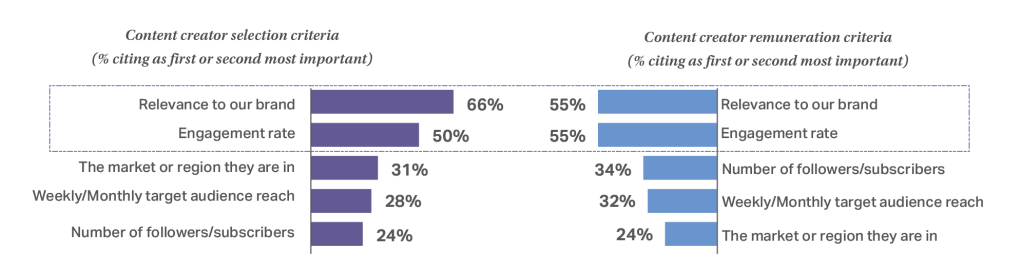
However, our interviews revealed that “brand alignment” can be hard to pin down, and ensuring both the right fit and quality engagement involves much more nuance. One CMO shared that selecting the right creator for their brand doesn’t come down to a set checklist: It’s a matter of “doing their homework”—and learning from past miscalculations. For another, it's a balance of reach versus authenticity—particularly in their industry, where creators with large audiences (10,000 or more) are often viewed as less trustworthy. Although seeking out creators with smaller audiences boosts brand credibility, it also increases the number of creators they must seek out and leverage to ensure widespread engagement.
When it comes to the activities marketing teams are using creators for, CMOs say that product reviews (45%) and sponsored content (43%) are the most important for their brand. And when it comes to evaluating ROI, they once again prioritize number of engagements (63%), followed by audience reach and frequency (42%). Even with measurement parameters in place, however, leaders must still navigate skepticism and tough questions from their C-suite peers about the effectiveness of creator marketing—often coming down to the percentage of sales being driven by this channel. This insight—combined with CMOs’ lack of confidence in decision-making data and persistent challenges in connecting metrics—signals an urgent need for unified measurement frameworks that not only consolidate content creator metrics but also tie them directly to business outcomes.
The CMOs we interviewed agreed that while the creator economy is currently a critical lever for their brand strategy, the pace at which technology and consumer behavior are evolving means it will only be a matter of time before the next new and disruptive channel emerges. Staying ahead of these shifts will require attention to the latest technology advancements, government regulations, and consumer data that can help identify shifting consumer trends.
Key takeaways
- Demonstrable ROI is the primary criterion for future marketing budget allocation, yet full-funnel ROI storytelling remains elusive, pushing CMOs to increase their investments in digital channels where ROI is most apparent.
- CMOs are heavily investing in influencers/content creators, yet C-suite skepticism and unclear ROI persist. CMOs prioritize brand alignment and engagement for selecting and remunerating creators, but particularly if it’s the first time they’ve leveraged the creator, the true ROI of such investments remains unclear until campaigns conclude. Despite these challenges, content creators remain a highly cost-effective mechanism to generate engaging content at scale.


Chapter 5:
From buzzword to business value: AI and its marketing mandate
Last year’s NIQ CMO Outlook report spotlighted the rise of AI (particularly generative AI) as a transformative force for accelerating marketing growth and efficiencies. At the time, most CMOs reported being in exploratory phases with GenAI, using it selectively for a handful of functions—top among them content creation, improving customer experience, and understanding customer behaviors.
One year later, the pressure to implement more AI efficiencies has only intensified. CMOs report mounting expectations from CEOs and CFOs to articulate an AI strategy—one that promises cost savings without compromising data integrity.
Yet for all the headlines and hype, our survey shows less movement in GenAI adoption compared with last year. Across functions—from customer insights to content creation—marketing teams remain in exploratory mode or are using AI only to some extent.
Is there a disconnect?


“[Companies] that aren’t laggards in tech and are able to maximize the upsides while responsibly navigating the limitations of AI will be the winners of the day.”
—Jing Mertoglu, Global VP Insights & Analytics | Marketing Excellence, Suntory Global Spirits
The stagnation might be less about reluctance and more about nuance: AI has been part of the marketing ecosystem for years—long before generative AI dominated headlines. Embedded functions like send-time optimization and automated journey orchestration were marketing technology (martech) stack table stakes long before they were marketed as “AI-powered.”
Where CMOs are putting GenAI to work
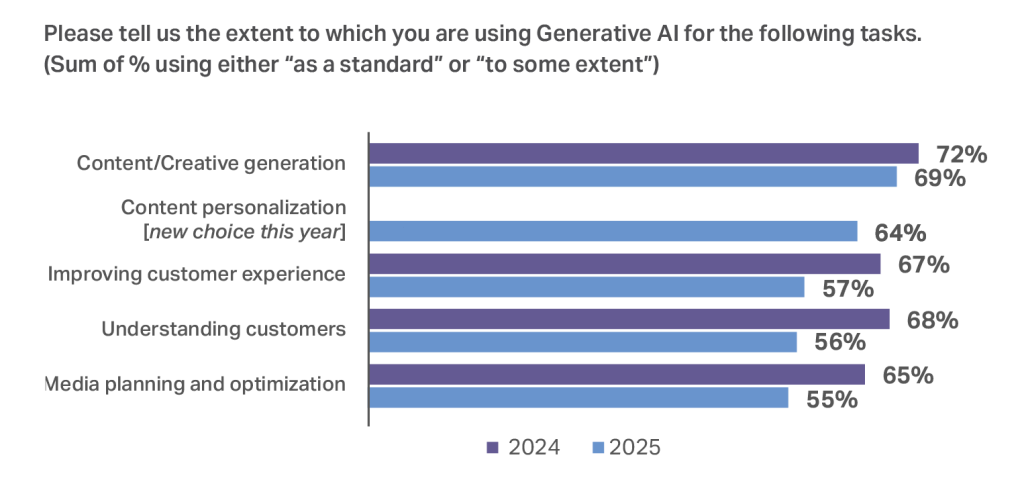

Although watchouts remain for accuracy issues like bias and hallucinations, the use of GenAI to some extent or as standard has been an easy win for marketers seeking efficiency in functions like desktop research, drafting briefs, and content marketing.
For CMOs, the question isn’t whether AI is a valuable asset; it’s whether its impact aligns with their desired outcomes. As one CMO who serves on their company’s AI taskforce noted, they are driving the technology, not the other way around. Use case is their primary focus when considering where and how to integrate AI.
Still, marketing leaders must clearly articulate and instill confidence in their cross-functional partners that they are sufficiently AI powered and driving impact—from efficiency gains to better budget allocation and ROI. To do this, CMOs should showcase tangible examples, framing these capabilities in terms of business outcomes, ensuring their stakeholders see the marketing organization as a tech-driven growth engine.
The new tension: When generative AI joins the creative table
Generative AI’s recent advancements offer vast potential to transform the advertising industry. An explosion of tools such as Google Veo 3.1, Runway Gen‑4, Adobe Firefly, Sora, Creatify.ai, and many, many more allow users to create text-to-video or image-to-video content that some say rivals human output—in seconds. For CMOs, this shift offers both thrilling opportunity and undeniable internal tension.
From a business standpoint, the appeal is clear. GenAI tools promise faster production, lower costs, and new creative possibilities. They can scale content production across channels, instantly adapt messaging for multiple audiences, and personalize campaigns in real time—freeing teams from repetitive work and compressing timelines that once stretched for weeks into days. Early adopters, from small businesses to major global brands, are already using AI to deliver winning ads faster. This speed-to-market advantage is especially appealing in today’s attention-fragmented environment, where agility can be the difference between leading and lagging.

Yet beneath the excitement lies a growing undercurrent of anxiety. Surveys show that many marketers—often more than 60%—fear AI could "steal their jobs” in areas ranging from copywriting and ad creation to video editing. As AI systems increasingly participate in the creative process, marketing teams are grappling with what “human creativity” now means, and whether brand authenticity can survive machine-generated output.
There’s a twist in this tale, however. Studies from sources as diverse as NIQ, academic researchers, and Shopify partners show that ads that are perceived as being AI-generated perform less well in areas such as memory activation, word of mouth, and purchase intention. Humans have an instinctive mistrust or antipathy for things they perceive as “fake.” Ads in which the imagery is AI-generated can outperform ads with human-generated images in terms of click-through rates, but only if these AI-generated images don’t look like AI.
For CMOs, GenAI can aid marketing organizations in becoming faster, more adaptive, and more productive. But, if deployed carelessly, it can dilute creative differentiation and weaken marketing performance. CMOs who strike the right balance will not only calm the fears within their organizations; they’ll redefine what creativity means in the AI era. That means positioning AI as a co-pilot, not as a replacement, and as an amplifier of human creativity rather than a substitute. It also requires investing in new skill sets—from “prompt” design to ethical oversight—and reshaping workflows so that human judgment remains central to brand storytelling and visual creation.
When it comes to AI adoption and its potential for high-impact marketing outcomes, the stakes seem highest for analytics and reporting—particularly as omnichannel strategies are increasingly a non-negotiable. As we noted in our previous chapter, CMOs must not only deliver seamless experiences across channels, they must also prove ROI/ROAS across on- and off-platform investments. Growing media fragmentation adds layers of complexity to this task, while the availability, accuracy, and integration of data that can empower AI capabilities poses even more challenges.
Perhaps the best example of this dynamic is with RMNs, which have become central to CMOs’ growth strategies: 69% say RMNs are growing in importance, while 67% expect RMN investments to increase in the coming year. Alignment with other marketing strategies and staying competitive were cited as the primary reasons for investing in this tool, while for others, RMNs are tied directly to distribution opportunities: 21% of CMOs say the top reason to invest in RMNs is to secure shelf space—a dynamic that creates a direct link between marketing and operational outcomes.


While slightly more than half (53%) of CMOs feel that RMNs offer adequate measurement and attribution for their business, proving incremental ROAS in this environment is daunting. No two retailers measure ROAS the same way, and retailer-specific data requires a significant investment (which can be hard for emerging brands in particular). Additionally, formulas are often opaque, leaving room for inaccuracy or misinterpretation. In fact, a Kellogg School of Management study found that the application of different methodologies can shift ROAS significantly, making it hard to know the true effectiveness of an ad.
AI can help synthesize disparate data sources, identify trends, and optimize spend—but only if the underlying data structure is strong. As some of the marketing leaders we interviewed pointed out, the ability to see the full view of high-frequency, highly granular omnichannel data and integrate it into AI platforms is a must. Without it, they are left with surface-level reporting that falls short of actual impact. As CMOs continue to explore new AI solutions, it’s important they think beyond simply driving efficiencies. Upholding credibility is key—and it starts with the integrity of the data these tools run on.
Because the AI push shows no signs of slowing down anytime soon, CMOs should simultaneously focus on building change resilience within their teams. By fostering a culture of exploration and curiosity—one that encourages experimentation while also preparing for the next iteration of technology, marketers will learn to integrate, adapt, and scale these new ways of working more quickly and effectively.
Start with the problem, not the platform
Incremental AI investment makes sense when it bridges gaps, unlocks new creative or decision-making capabilities, or can effectively automate work that otherwise requires human hours that could be spent on other tasks (i.e., it should free up time to work on other things). We asked CMOs to share more about the criteria they use to assess new AI vendors, solutions, or integrations. They pointed to the following:
- Efficiency vs. innovation: Is the goal to optimize what exists or to unlock new capabilities?
- Redundancies: Are existing tools already solving for the same outcomes that AI promises?
- Integration: Can AI capabilities plug into current platforms? Do they add silos or facilitate more connectivity?
- Human bandwidth: Are teams still spending manual hours on repetitive work that AI could automate more intelligently, freeing them to spend time on other tasks?

Key takeaways
- C-suite pressure for AI-driven efficiencies is intensifying, and the goalposts for generative AI adoption keep shifting. GenAI tools are now firmly embedded in both strategic and tactical execution across global marketing teams. What remains an area of concern for CMOs, however, is what percentage of that work product should be external versus internal. Secondarily, quality control remains a primary focus for CMOs.
- AI tools offer speed and scale for content creation, enabling rapid adoption across channels. But research shows that AI-generated ads often underperform in distribution, potentially eroding brand trust and reducing conversion. CMOs must find the balance between leveraging GenAI solutions and human expertise to meet organizational goals of increased efficiency while maintaining brand equity.
- Beyond GenAI, the vast majority of AI’s promise lies in its ability to unify fragmented platforms and analyze performance across channels, including retail media networks.
- CMOs’ primary objectives remain harnessing the full potential of AI-driven marketing solutions, investing in new AI solutions that will improve efficiency, and effectively communicating the value of their martech stack to cross-functional partners and the C-suite.

Chapter 6:
Charting the course ahead
The days of “good enough” in marketing are over: Vanity metrics and gut-driven decisions are no longer passable, and budgets hang in the balance as CMOs are being challenged to dig deeper into the data, balance short-term wins with long-term growth, and embrace emerging technologies in their day-to-day operations.
Despite these shifts, there are signs of resiliency: CMOs are confident (for now) in their established brand equity, their marketing teams are slowly adopting more sophisticated tech and analytics capabilities, and their three-year outlook on growth remains optimistic.
To win in 2026, brands must accept that disruption and complexity are no longer exceptions but rather, part of the new operating environment—and respond accordingly. The path forward will demand even more budget recalibration and data-based decisioning, pressuring marketing leaders to move beyond reporting to real optimization.

To rise to this challenge, CMOs should integrate the following actions and tools into their toolkit as they build their 2026 strategies:
| Action | Why it matters | How NIQ can help |
|---|---|---|
| Stay ahead of market conditions and consumer trends | If the last decade has taught leaders anything, it’s that success doesn’t come from reacting to disruption but rather, from staying two steps ahead of it. Anticipating change means staying attuned to the big picture of market, category, and competitor dynamics, as well as consumer trends and motivations. By rooting marketing agility in foundational data, CMOs can make better decisions about media investments, digital shelf optimizations, and new growth opportunities. | NIQ Consumer Life NIQ Omnichannel Commerce NIQ Omnishopper |
| Assess your brand and marketing effectiveness | No matter how well-known or established it is, a strong brand is never stagnant—it’s constantly tested, evaluated, and optimized to ensure it effectively resonates with its target audience. As CMOs navigate consumer shifts, new media channels, and rising expectations, they must also assess their creative, ensure they’re reaching their target audience, and nurture brand loyalty. | NIQ Audiences & Personalization NIQ Brand Architect NIQ Growth Architect NIQ Marketing Effectiveness |
| Connect data ecosystems | CMOs need more than data in isolation—they need connected intelligence that provides a full view of the consumer and retailer landscape, accessible in a centralized location. By empowering teams with data access, leaders can break down cross-functional silos and align behind a single source of truth, empowering them to move more quickly and with precision. | NIQ Marketing Effectiveness |
| Maximize ROI through better campaign management and measurement | As CMOs face increased pressure to justify marketing investments, they need a holistic and unbiased view of performance. Analytics tools like Marketing Mix Modeling (MMM) analyze data across the total store to determine what truly drives sales and brand outcomes, while integrated platforms can reduce RMN fragmentation by consolidating data, activation, and measurement capabilities. When equipped with this information, marketing leaders can take more decisive action on investment decisions and resource allocation. | NIQ Audiences & Personalization NIQ Marketing Effectiveness |
| Leverage AI-powered technology for better data-decisioning | Descriptive analytics can offer a robust snapshot of what happened—but to stay ahead of disruptions, CMOs must also understand what will happen next (predictive analytics) and what to do about it (prescriptive analytics). Keeping in mind that any robust analysis requires a foundation of best-in-class data, AI technology has democratized advanced capabilities, making it possible for teams to analyze massive volumes of data, detect patterns, forecast outcomes, and receive data-driven recommendations. | AI at NIQ |
As marketing leaders recalibrate their day-to-day remit, their path forward demands integration—of teams, technology, and data. In 2026, their success will hinge on the ability to meet uncertainty with insight, turn complexity into clarity, and lead their brands with precision and purpose.